File 01
The price of forgetting
Why your computer gets hot, and what it is really paying for.




A thread on energy, memory and entropy: why every computer gets hot, and the one cost that physics will never let it avoid.
The thread
- 01
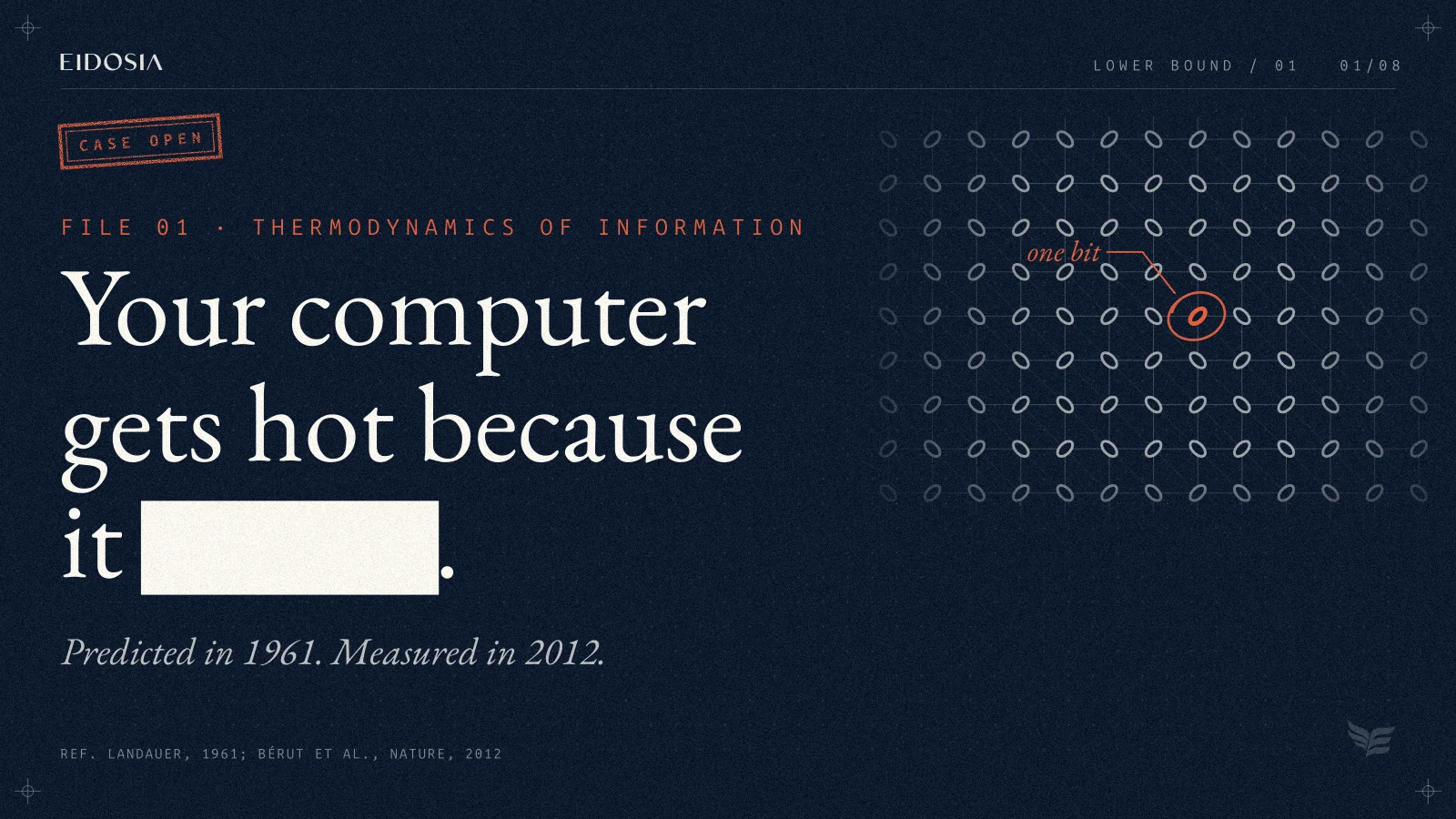
Your computer does not get hot because it thinks.
It gets hot because of one thing it does billions of times per second.
Predicted in 1961. Measured in a lab in 2012.
- 02
It forgets.
Every time a computer erases a bit, physics sends a bill, paid in heat.
This is not a metaphor. It is thermodynamics.
- 03
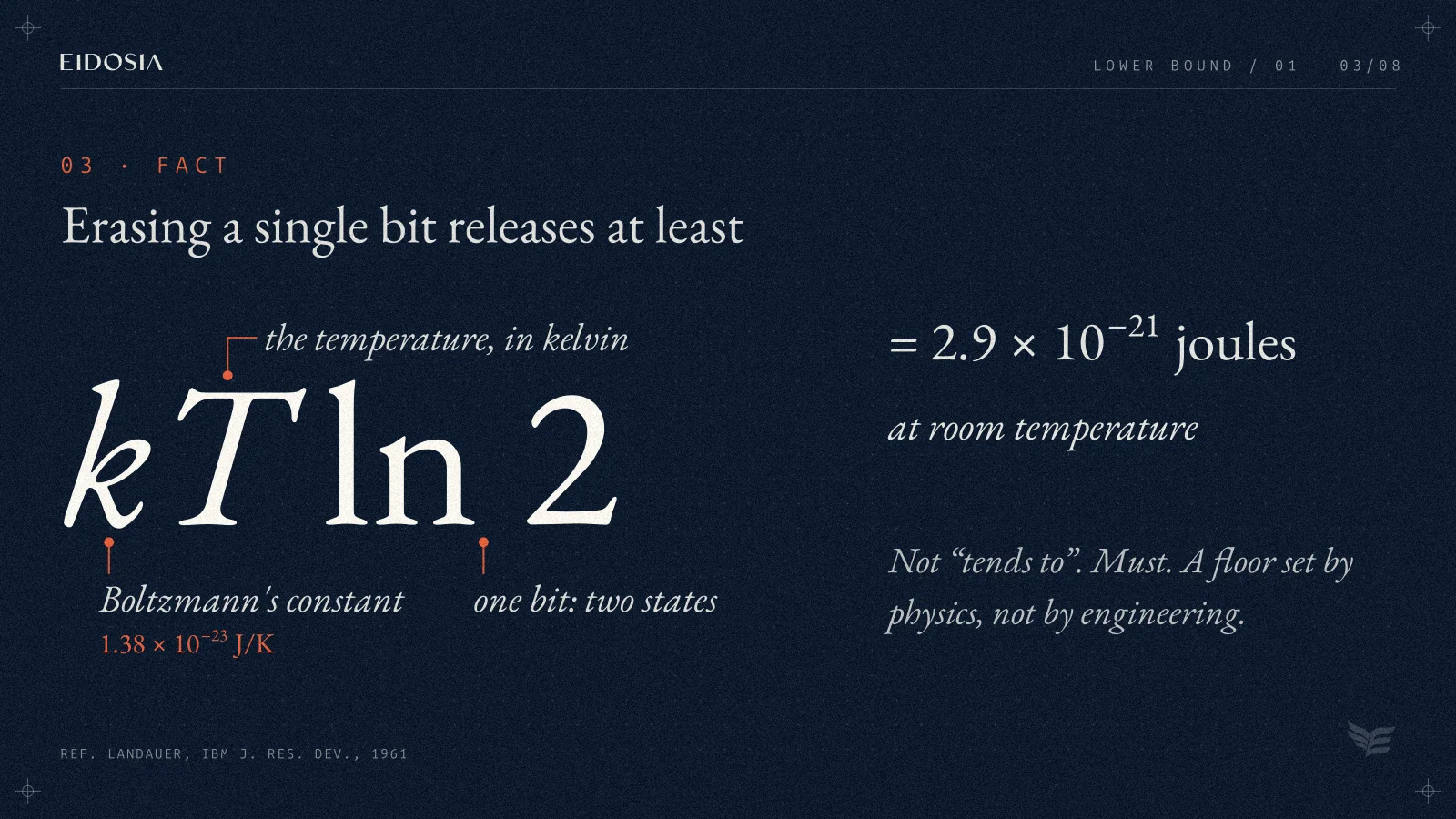
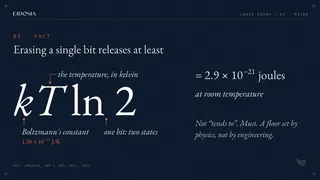
Rolf Landauer, IBM, 1961: erasing a single bit must release at least kT ln 2 of heat.
At room temperature, that is 2.9 × 10⁻²¹ joules.
Not “tends to”. Must. A floor set by physics, not by engineering.
- 04
Here is where intuition breaks.
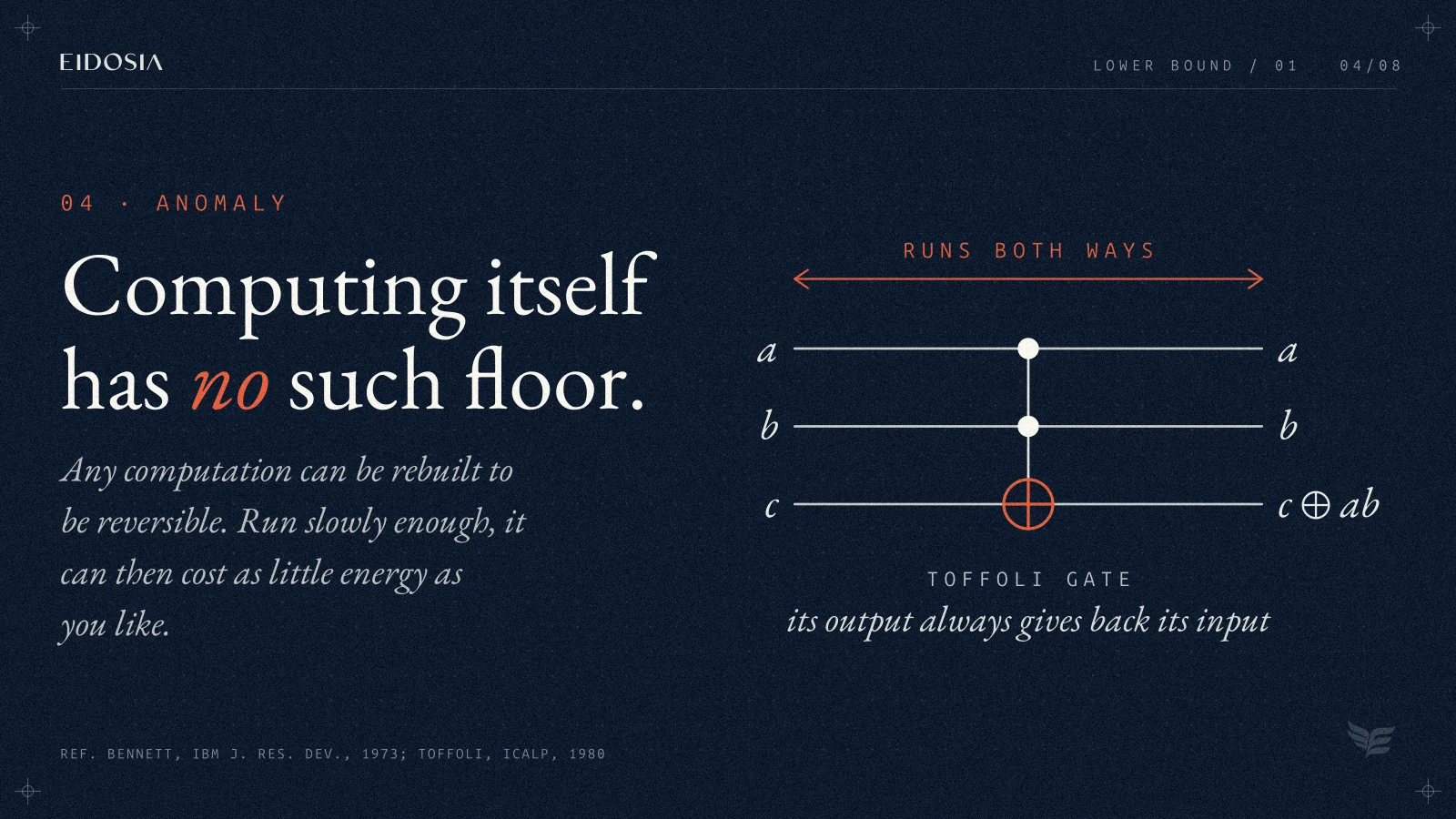
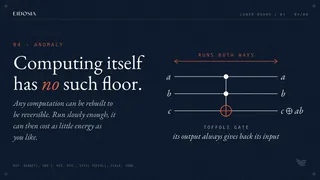
Computing itself has no such floor. Charles Bennett showed in 1973 that any computation can be rebuilt to be reversible.
Run slowly enough, a reversible computation can cost as little energy as you like.
- 05
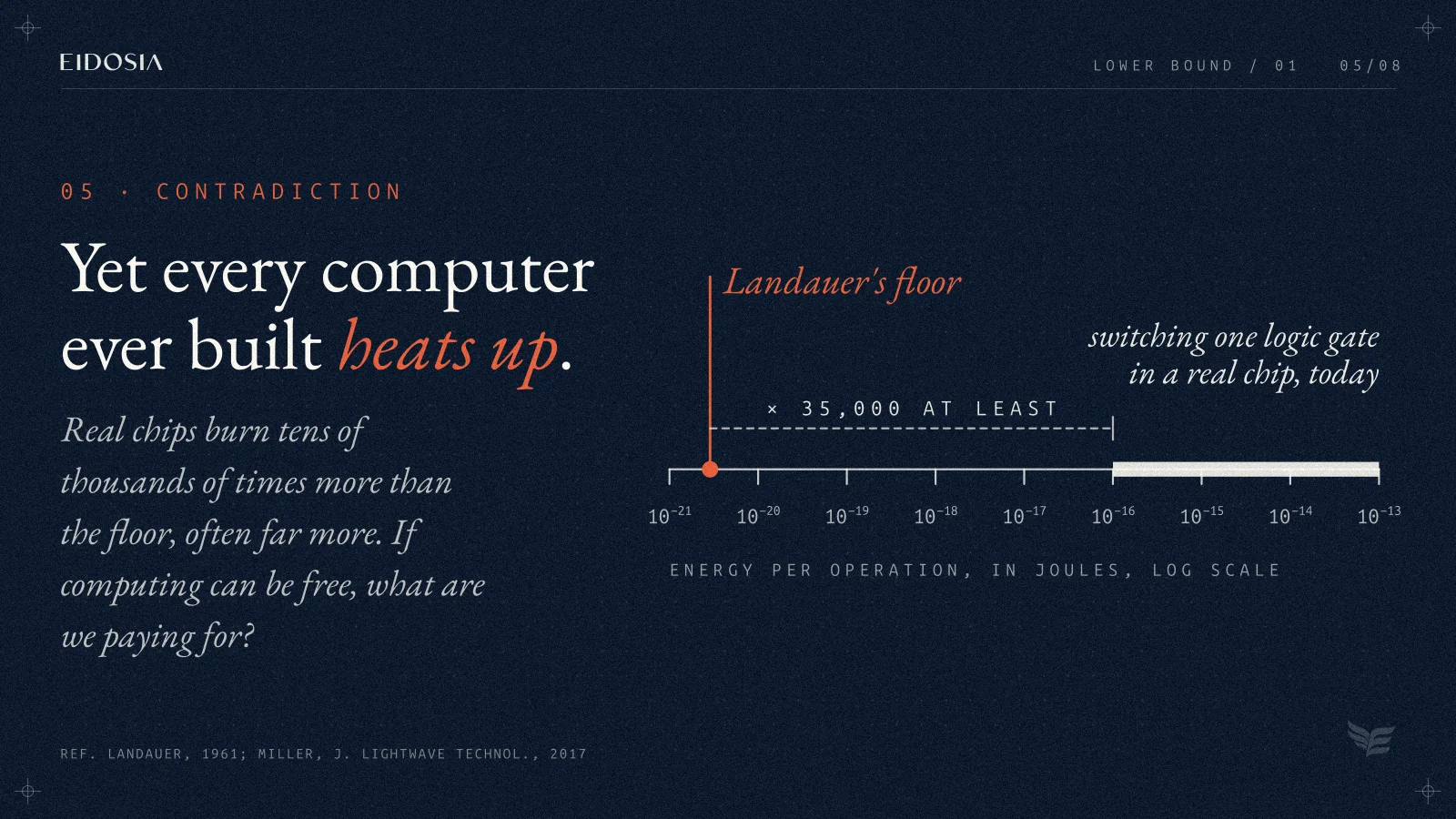
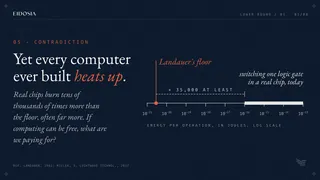
Yet every computer ever built heats up.
Switching a single logic gate in a real chip costs tens of thousands to tens of millions of times Landauer's floor.
So if computing can be free, what exactly are we paying for?
- 06
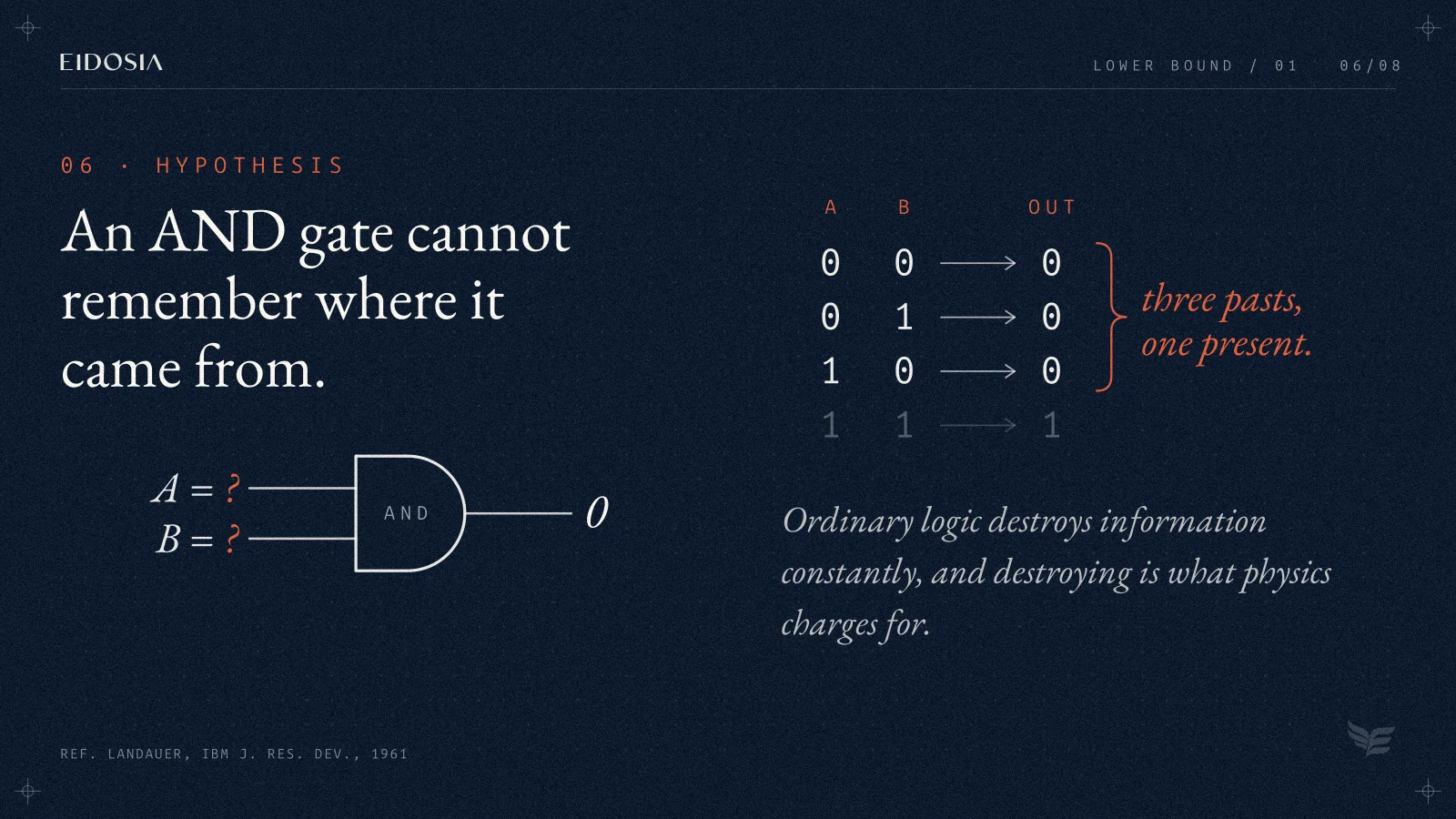
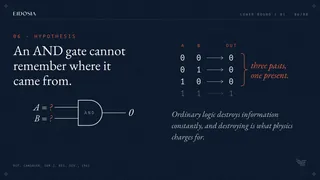
Look at an AND gate. It takes two bits and returns one.
If the output is 0, the input could have been 00, 01 or 10. Three different pasts, one present.
Physics does not charge the gate for computing. It charges it for destroying.
- 07
This also quietly rescued physics.
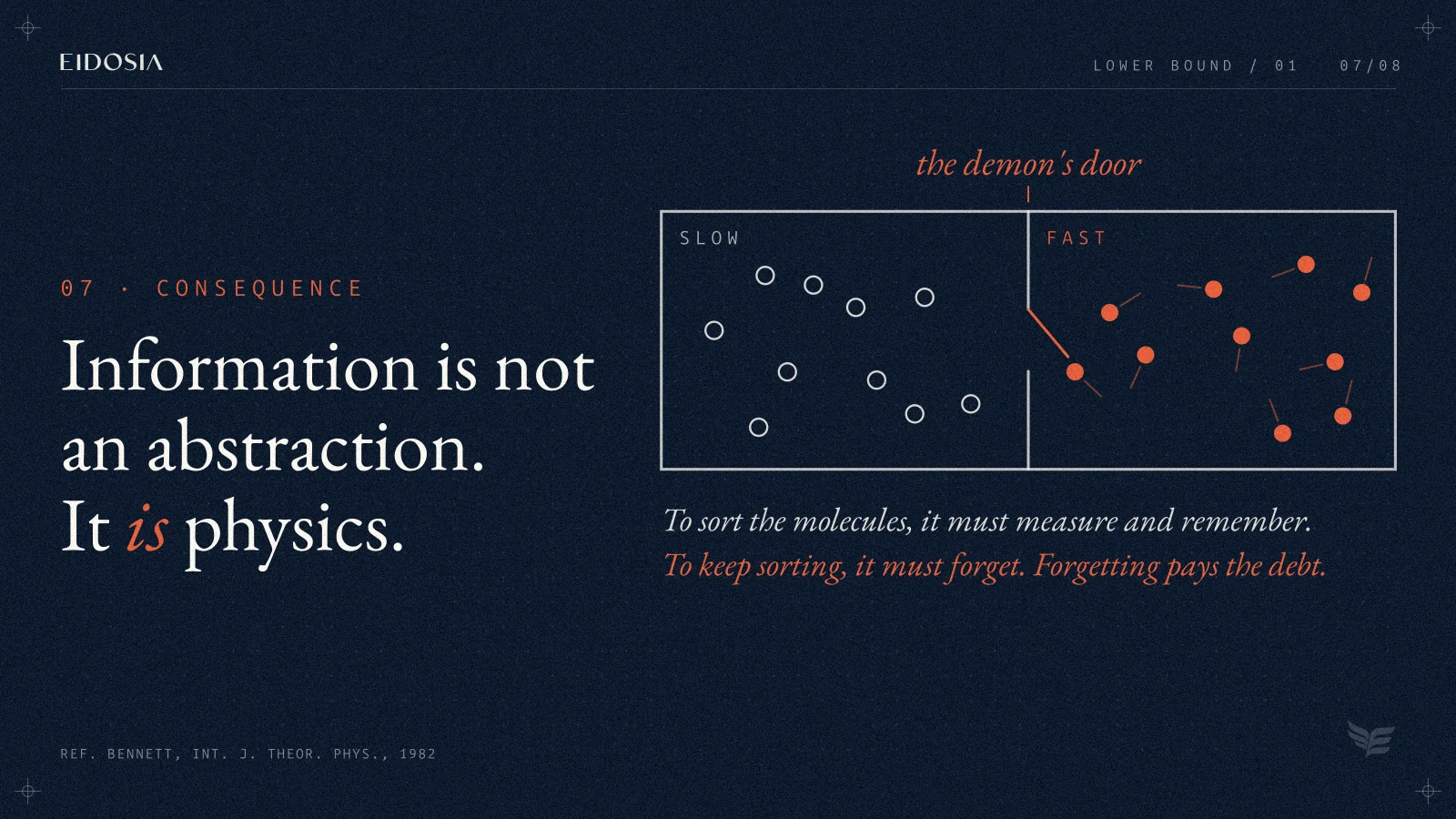
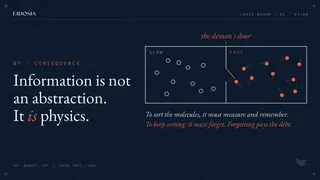
Maxwell's demon seemed to beat the second law of thermodynamics. It fails because it must eventually erase what it learned, and that erasure pays the debt in full.
Information is not an abstraction. It is physics.
- 08
So every bit you keep is a bill you have not paid yet.
A finite memory that keeps learning must one day erase to make room. And physics caps how much information any region of space can hold.
Can anything remember forever?
Sources
- 01R. Landauer (1961). Irreversibility and heat generation in the computing process. IBM Journal of Research and Development 5, 183.doi:10.1147/rd.53.0183
- 02C. H. Bennett (1973). Logical reversibility of computation. IBM Journal of Research and Development 17, 525.doi:10.1147/rd.176.0525
- 03T. Toffoli (1980). Reversible computing. ICALP 1980, Lecture Notes in Computer Science 85, 632.doi:10.1007/3-540-10003-2_104
- 04J. D. Bekenstein (1981). Universal upper bound on the entropy-to-energy ratio for bounded systems. Physical Review D 23, 287.doi:10.1103/PhysRevD.23.287
- 05C. H. Bennett (1982). International Journal of Theoretical Physics 21, 905.doi:10.1007/BF02084158
- 06A. Bérut et al. (2012). Experimental verification of Landauer's principle linking information and thermodynamics. Nature 483, 187.doi:10.1038/nature10872
- 07D. A. B. Miller (2017). Attojoule optoelectronics for low-energy information processing and communications. Journal of Lightwave Technology 35, 346.doi:10.1109/JLT.2017.2647779